

A focus on the textile circular economy, alternative fibres and safety solutions in Geneva
STFI at INDEX 2026
From 19 to 22 May 2026, INDEXTM will invite visitors to Lake Geneva for the world’s leading nonwovens trade fair. The Centre of Excellence in Nonwovens at the Sächsisches Textilforschungsinstitut e.V. (STFI) will be in attendance to present the latest developments in nonwovens research. In the field of the textile circular economy, the STFI will present acoustically effective nonwovens made from chemical recycling residues. The range also includes innovations aimed at replacing conventional raw materials, such as the biobased and biodegradable polymer polybutylene succinate (PBS) and Kendyr as an alternative to cotton. One of the highlights will be the ring-spun yarn produced from the straw of the Kendyr plant. The advantage of Kendyr is that it thrives on soils that have become salinated due to long-term cotton cultivation. Meet our exhibition team at Stand 1369 in Geneva.
Textile circular economy: Acoustically effective non-woven fabrics from chemical recycling residues
Chemical recycling of mixed textile fractions produces textile residues that are currently mostly not reused as material, but instead thermally recovered or disposed of. To facilitate further recycling, the STFI, in cooperation with the company Refresh Global, is investigating efficient processing and treatment methods to enable these textile residues to be reused. They can be used in sound-absorbing design products, such as acoustic walls or furniture. Nonwoven formation processes are particularly suitable for processing these textile residues. At STFI, the recycled materials are mechanically processed on pilot-scale plants at laboratory or semi-industrial scale before being formed into a nonwoven fabric and consolidated. Through appropriate finishing, a visually suitable top layer can also be integrated directly onto the nonwoven fabric. Under the use of samples on our booth, possible applications as acoustic pictures and a miniature sound box are shown.
Bulletproof: Ballistic composite textile
Shown at INDEX will be a ballistic composite textile based on nonwoven fabrics, which, through shaping and design, can be used to equip structural elements, particularly the interior areas of buildings, especially shooting ranges. The research resulted in a three-dimensional, pressure-stable and rigid nonwoven composite that is not only able to catch shrapnels and meets fire class B1 according to DIN 4102-1, but is also extremely sound-absorbing and provides excellent damping in critical frequency ranges. The nonwoven composite was processed and tested in practical panels suitable for the refurbishment of bulletproof floors, walls and ceilings in enclosed shooting ranges.
Rubio: Central German alliance for bioplastics
The development of sustainable plastic solutions is rapidly gaining importance in the face of global environmental pressures, dwindling fossil resources and ambitious climate protection targets. As part of the regional RUBIO alliance, which brings together 18 partners from Central Germany and the Berlin-Brandenburg region, the biobased and biodegradable polymer polybutylene succinate (PBS) was comprehensively investigated, from the raw material through the manufacturing process to industrial application. The aim was to assess the potential of PBS as an environmentally friendly alternative to polyethylene and to lay the technological foundations for new sustainable value chains. As a partner in the alliance, the STFI was able to demonstrate, using the example of a net for straw bales, that the bioplastic PBS is suitable for textile processing. The results include spunbond nonwovens, ribbons and textile structures. A knitted straw bale net has been successfully developed that meets the DLG’s (German Agricultural Society) requirements for novel biobased plastics in terms of mechanical properties.
Renewable raw materials: Kendyr – a climate-friendly alternative to cotton
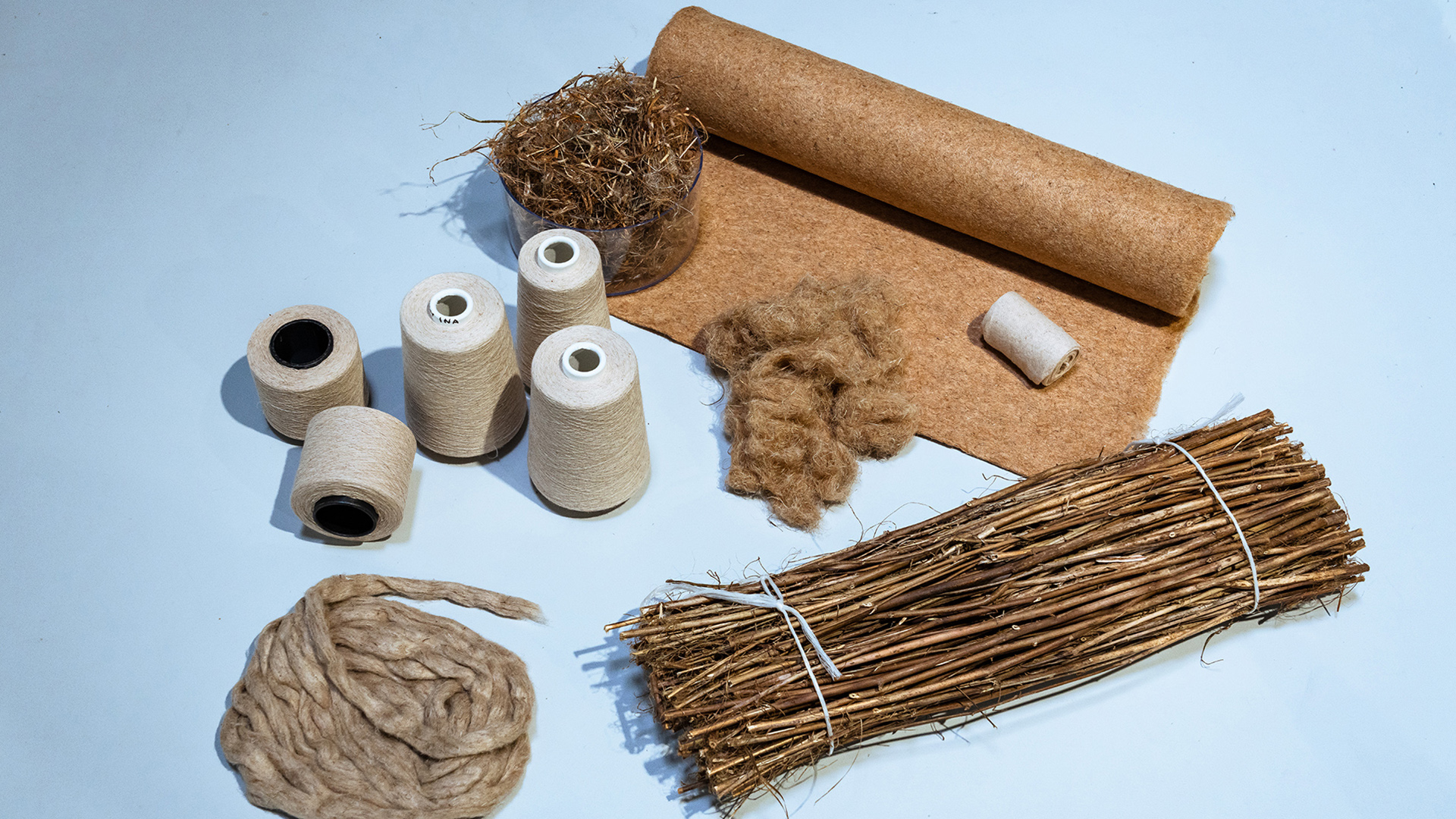
In many arid regions of the world, particularly in Central Asia, decades of irrigating cotton fields are increasingly leading to soil salinisation – with serious consequences for soil fertility and thus the future of cotton cultivation. In the long term, this development threatens the global supply of raw materials to the textile industry. An international research collaboration involving the Sächsisches Textilforschungsinstitut e. V. (STFI) has therefore investigated the potential of alternative raw material plants, specifically Kendyr. The investigations confirmed the potential of Kendyr fibres, which were spun on an industrial scale in a blend with 70% cotton into a 30-tex ring-spun yarn (Nm 34) using a process-stable method and knitted into lightweight knitwear (110–140 g/m²).
Visit us at Stand 1369 in Geneva from 19–22 May 2026.