
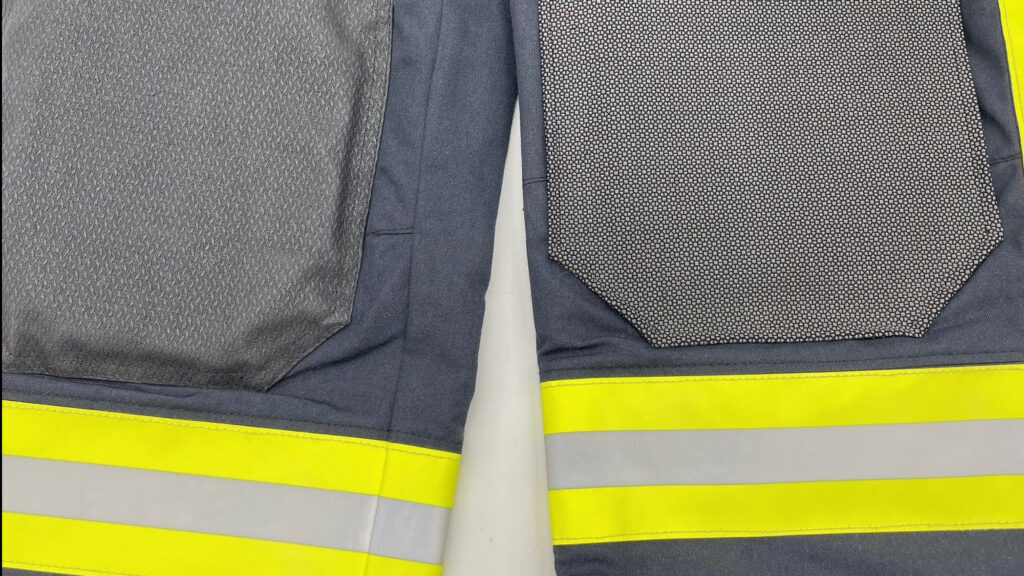
eco-friendly, flame-retardant, abrasion-resistant, and segmented protective coating, including a substrate, for use in firefighter clothing
Objective
The project focused on the development of a sustainable, eco-friendly, flame-retardant, abrasion-resistant, and segmented protective coating. Firefighter clothing was identified as a primary area of application. However, applications in personal and occupational safety are also interesting. The goal of this development was to improve the durability and comfort of protective clothing.
Approach and results
The project partner, Theodolf Fritsche GmbH, was responsible for developing the textile substrate materials. A key part of the work involved selecting and evaluating yarn materials, developing fabrics, and manufacturing the fabrics. A fabric made of a Kevlar stretch-broken fibre material was selected, which was treated with a hydrophilic pretreatment to ensure good adhesion of the segmented protec-tive coatings.
The STFI’s primary task was to develop the coating materials and subsequently test the resulting func-tionalities. A formulation was selected that included a biopolymer-based binder system, additives for high strength, and mineral flame retardants. Functional samples were produced on the Kevlar fabric using this coating formulation. These samples demonstrated high abrasion resistance in accordance with DIN EN 388:2019-03 as well as very good flame-retardant protection (DIN EN ISO 15025).
The project partner, Mayer GmbH TechConcepts, was responsible for developing the industrial appli-cation process for the efficient coating of the textile substrates. The focus was on rotary screen printing as a continuous roll-to-roll process for producing three-dimensional segmented coatings. Using the developed process, the textile carrier materials were successfully produced with the coating formulations under industrial conditions. This led to the production of functional samples, which were integrated into firefighter clothing and a protective suit for demonstration purposes.