
Monitor mechanical stresses using sandwich-structured surface elements
Objective
In technical applications, mechanically loaded sheet-like structures are often monitored only locally or retrospectively. As a result, large-area load distributions, local pressure redistributions, elastic de-formations, or environmentally induced changes in condition can only be detected to a limited extent. This created the need for a scalable textile surface element that combines load-bearing, elastic, and sensing functions within a single structure. The objective was to develop a large-area, sandwich-structured sensor surface capable of detecting mechanical loads directly, integrally, and continuous-ly. The innovative approach was based on the combination of spacer fabrics, functional coatings, additive manufacturing, and measurement data acquisition.
Approach and result
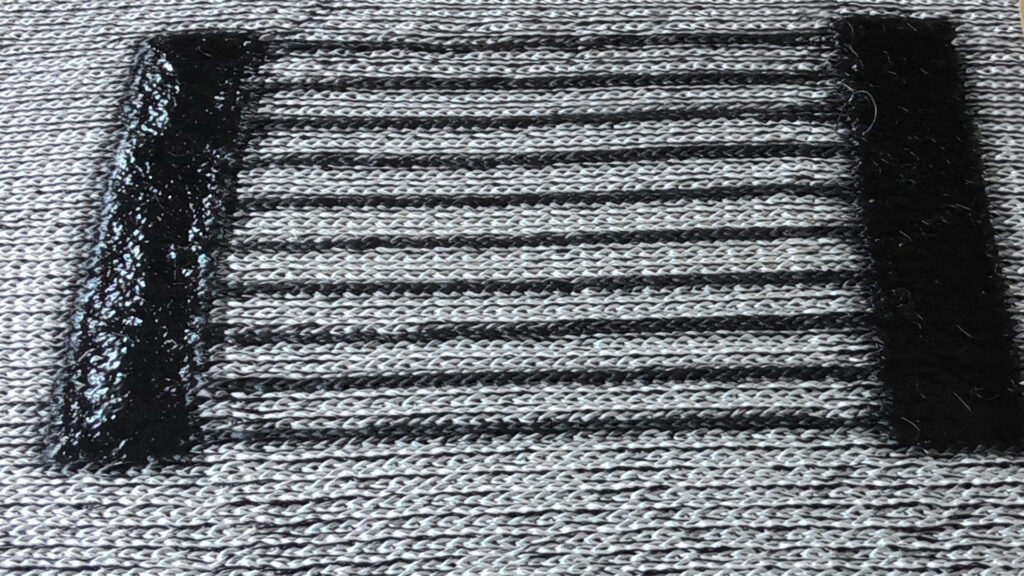
Within the project, textile multilayer and spacer fabrics were developed as a stable yet elastically deformable base structure. For this purpose, binding patterns and material combinations were developed that enable the positionally accurate integration of sensitive areas and address the conflicting requirements of stiffness, elasticity, and signal generation. In addition, conductive, sensitive, and dissipative coating and filler systems were developed and adapted to the flexibility, extensibility, and drapability of the textile substrates. In addition to conventional knife coating, Liquid Additive Manufacturing were used to apply the coating materials. In parallel, a measurement system for signal acquisition and processing was implemented. This enabled the interconnection of a measurement array comprising up to eight sensors and demonstrated the detection of different load states.