
An eco-friendly alternative to fluorocarbon treatments
New dispersions are kinder to the environment
Protective and outdoor clothing derives its durable water-, dirt- and oil-repellent properties from the application of fluorinated polymers or per- and polyfluorinated low-molecular-weight chemicals (PFCs). The beneficial properties thus achieved on textiles are offset by environmental and human health risks. For manufacturers of sports, medical, protective and automotive textiles, researchers at the Sächsisches Textilforschungsinstitut e.V. and the Leibniz Institute for Polymer Research have developed liquid-applied dispersions and solutions to functionalise textiles without the use of fluorine. The outdoor textiles tested exhibited water-repellent and, in particular, highly oil-repellent properties. The new dispersions and solutions can help reduce the burden on ecosystems.
Objective
Fluorocarbons impart an exceptional property to textiles such as fire-fighter’s clothing, weatherproof jackets or surgical gowns: they repel water, oil and dirt, meaning they are both hydrophobic and oleophobic. Due to their extreme persistence and toxicity to humans and the environment, their continued use must be called into question. Per- and polyfluoroalkyl substances (PFAS), also known as ‘forever chemicals’, are virtually non-biodegradable and are increasingly accumulating in the environment. For this reason, their use is regulated by the European REACH Regulation, and the aim is to impose severe restrictions on their use. The textile industry is also significantly affected by this. Until now, it has not been possible to develop high-performance fluorine-free products, particularly those with oil-repellent properties. In the IGF project ‘C6C8 turn green’, textile researchers from the STFI in Chemnitz and chemists at the Leibniz Institute for Polymer Research in Dresden have now developed an environmentally friendly alternative to fluorocarbon finishing.
Aproach
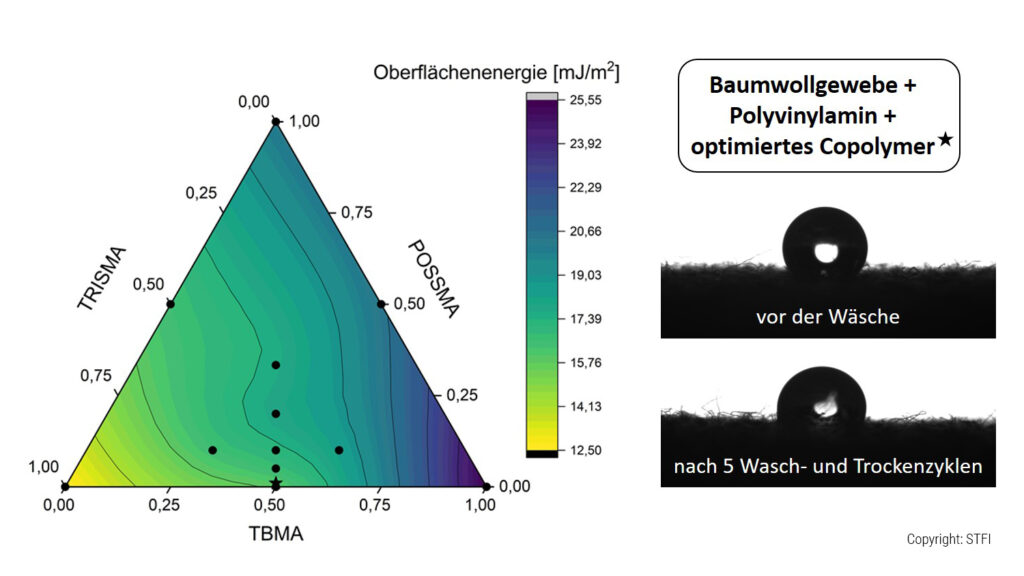
The project focused on the use of POSS (polyhedral oligomeric silsesquioxanes) and TRIS compounds ([Tris(trimethylsiloxy)silyl]) to achieve water and oil-repellent effect. Copolymer systems consisting of tert-butyl methacrylate (TBMA) and methacrylate-functionalised POSS (POS-SMA) and TRIS (TRISMA) were specifically synthesised. For the textile finishing, aqueous dispersions of the copolymer systems were produced using mini-emulsion polymerisation. Functionalisation of the textiles began with the application of an adhesion-promoting polyamine finish comprising cross-linking agent-containing aqueous polyvinylamine or chitosan formulations. In a second process step, the textiles were functionalised with the copolymer dispersion. Application was carried out in each case using foulards, followed by thermal drying and cross-linking.
Results
To assess the effectiveness, the functionalised cotton fabrics were examined before and after defined washing cycles at a washing temperature of 60 °C, followed by tumble drying at 70 °C. The samples achieved a contact angle against water of up to 129° before and 112° after five wash and dry cycles. With contact angles against ethylene glycol of up to 123° (before washing) and 106° (after washing), an oleophobic effect was demonstrated.
The fundamental benefit of a PFC-free finish lies in reducing the burden on ecosystems. By creating an environmentally friendly alternative, the release of pollutants into the air, water and soil can be reduced. This provides textile manufacturers with a high-performance alternative.