
Regional hemp bast for lightweight construction profiles
Establishment of a regional, bio-based value chain for fibre-reinforced plastics
The cultivation of fibre hemp for the production of ropes and clothing has a long tradition in Saxony. Due to its excellent fibre properties, it is also suitable as a renewable raw material for reinforcement in fibre composites. At the STFI and IWU in Chemnitz, the CannaPul project is currently investigating how a regional value chain for hemp-based lightweight construction profiles can be established. To this end, the technical processing of hemp fibres into continuous fibre strands and their embedding in a suitable bio-based matrix are being investigated.
The starting point
Fibre-reinforced plastics are materials consisting of reinforcing fibres and a plastic matrix, and have established themselves as versatile and high-performance materials with high strength and stiffness. ultrusion is a continuous manufacturing process used to produce high-quality fibre-reinforced profiles. Continuous fibre strands made of glass, carbon or natural fibres, known as rovings, are drawn through a thermosetting resin bath into a heated mould and thermally cured. This produces high-quality profiles with a constant cross-section, high strength and low weight, which are ideally suited to applications requiring lightness, corrosion resistance and durability. The aim is to replace the petroleum-based components with bio-based raw materials in the future.
The objective
The central challenge in the CannaPul research project is the development and application of bio-based, regionally available materials. The aim is to produce continuous-fibre-reinforced profile structures from hemp bast fibres in combination with a bio-based thermoplastic matrix. A prerequisite for this is, on the one hand, the provision of suitable natural fibre strands from the renewable regional raw material hemp bast. On the other hand, the process requires the application of a thermoplastic biopolymer matrix with low viscosity and correspondingly high flowability, as well as a low melting temperature, to prevent thermal damage or burning of the hemp fibres.
The collaboration
The project partners in CannaPul are the Sächsisches Textilforschungsinstitut e. V. Chemnitz (STFI) and the Fraunhofer Institute for Machine Tools and Forming Technology IWU Chemnitz (IWU).
The STFI is investigating the textile processing of high-strength hemp bast strips into continuous fibre strands and, as a result, is providing bio-based reinforcing fibres for the pultrusion process. The peeled hemp bast strips are separated by a fibrillation process and deposited evenly as a ribbon. The ribbon is stabilised against tensile stress through a coating process and made available as yarn.
The IWU is addressing the numerous challenges involved in the pultrusion process. The aim here is to match the viscosity of the melt and the processing temperature of the thermoplastic to the biogenic fibre material.
The process
In pultrusion, the thermoplastic melt is produced from granules. The challenge lies in the complete impregnation of the fibres and ensuring an even fibre distribution. At the same time, a fibre volume fraction of at least 50% must be achieved to ensure high mechanical properties, in particular a high specific (weight-based) tensile strength. At a pull-off speed of up to 1000 mm/min, a cross-sectional area of 20 mm² must be reliably and completely impregnated with the thermoplastic melt during pultrusion.
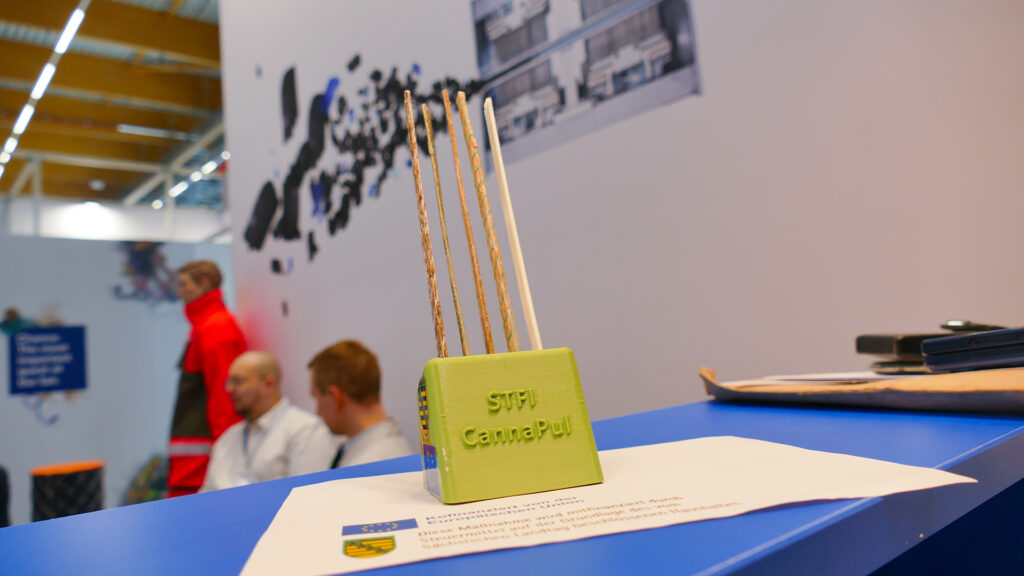
Heike Metschies, project manager at STFI, notes: “Initial results are already available in the form of rectangular profiles with hemp reinforcement and a thermoplastic matrix. We were able to present these at AGRA 26 in Leipzig to, among others, the Saxon Minister of State for the Environment and Agriculture, Georg-Ludwig von Breitenbuch, and to a large specialist audience at Techtextil in Frankfurt am Main.“
Outlook
As the CannaPul project progresses, the substitution of the currently petroleum-based thermoplastic matrix with a biogenic thermoplastic matrix will be investigated, the profile cross-section will be increased, and further efforts will be made to improve the quality of the hemp fibre roving.
Acknowledgements
The project is co-financed by tax revenue from the European Union and the Free State of Saxony under the Regional Development Programme (ERDF) and the Just Transition Fund (JTF) for the funding period 2021 to 2027.
(Press release from 5.5.2026)