
Humic substances for the antiviral functionalisation of ecologically sustainable nonwovens for respiratory masks
Objective
Incorrect or careless handling of masks that are in use or have been used carries the risk of unintentionally spreading active viral particles present on the mask. Furthermore, the use of fossil raw materials in mask production contributes to an increase of carbon footprint, whilst improper disposal exacerbates the global plastic waste problem. Therefore, the aim of the research project was to develop a bio-based and biodegradable textile composite for particle-filtering half masks, as well as a novel, environmentally friendly antiviral finish for it.
Approach and results
Spunbonded and meltblown polylactide (PLA) nonwovens of varying grammage and porosity were combined in layers and assessed for their suitability and processability for use in respiratory masks. In addition, methods were developed to impart antiviral properties to the meltblown filter fabric layer using a polyaminosaccharide-based binder system (chitosan) and naturally occurring humic substances. Beside the application by dip-coating followed by drying, the suitability of low-energy, non-thermal electron beam (e-beam) technology for gentle and energy-efficient surface functionalisation was investigated.
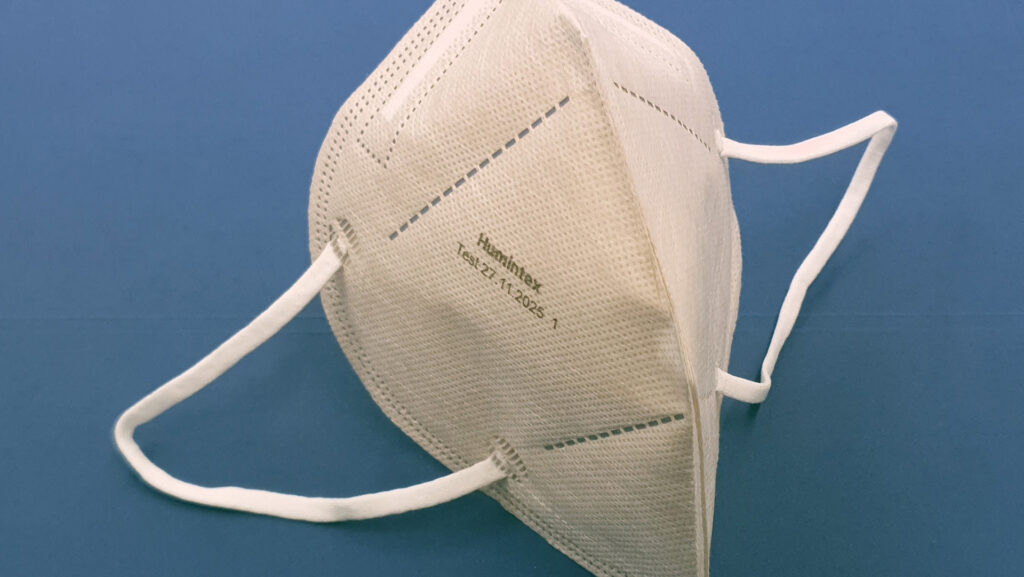
The result of this work is a particle-filtering half mask with an antiviral-functionalised filter layer. The material composition is based primarily on renewable raw materials and biodegradable materials, highlighting the potential for sustainable material and process alternatives in the field of protective equipment and other nonwoven-based applications.