
textile titanium nonwoven structures for use in composites with ceramic substrates
Objective
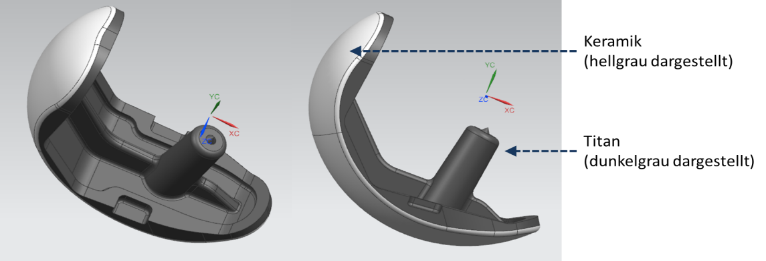
The goal is to embed titanium nonwoven structures into a ceramic substrate using ceramic injection molding, thereby creating a metallic, textile-like surface structure on the ceramic. This approach enables the creation of a composite with entirely new combinations of properties. This approach is intended to enable the large-scale production of complex-shaped ceramic components in the future, featuring a metallic textile structure on their surface that, for example, facilitates the ingrowth of bone cells—in the case of implant components—more effectively than conventional porous coatings. The production and further processing of titanium fibres into textile nonwoven structures has not yet been commercially pursued and was an initial subproject goal. The combination of materials will primarily find application in medical technology.
Approach and results
Composites made of titanium nonwoven fabric and zirconia were developed using injection molding technology, with a view to their future use in medical products (orthopedic implants). For the first time, titanium fibers were successfully produced as continuous fiber strands using the Strehl process. Challenges remain regarding the fineness and brittleness of the fibers in the carding process. In addition, modifications to the equipment, specifically regarding the tooling and roller spacing, would be necessary. Additionally, Titanium nonwovens were produced using Airlaid technology. The nonwovens were suitable for use as inserts in injection molding. However, there is still room for improvement regarding the uniformity of fiber deposition and the complete integration of the titanium fibers into the nonwoven.